
This series of articles seeks to examine the character attributes of highly successful leaders, regardless of their adherence to a strong faith or moral standard. In presenting these thoughts, Leadership Ministries is not agreeing with or advocating these traits or practices, but rather presents these as ideas for discussion and development in your own leadership journey.
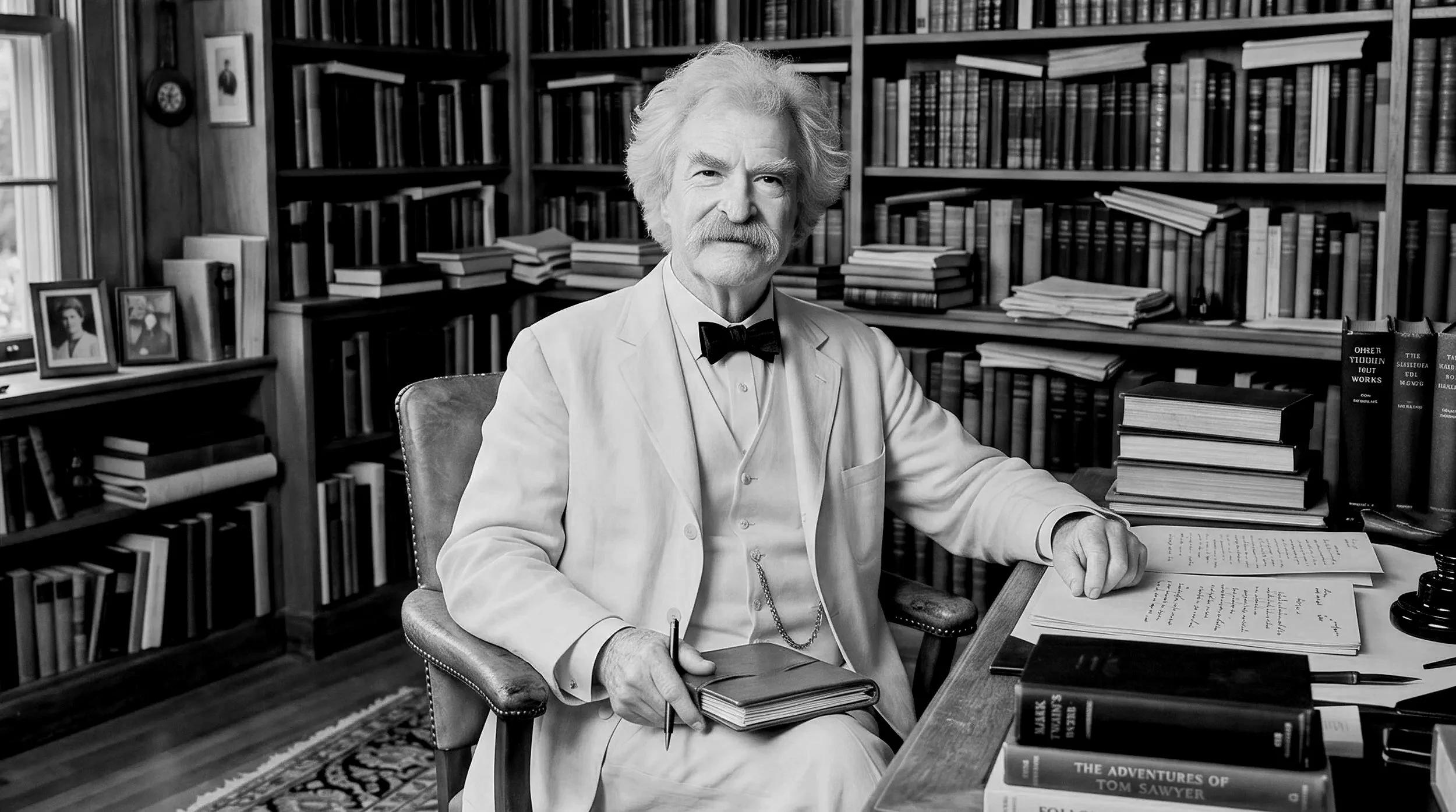
Mark Twain (1835-1910) was one of the most celebrated writers and cultural commentators in American history. Born Samuel Langhorne Clemens in Missouri, Twain was raised in the town of Hannibal along the Mississippi River. He absorbed the rhythms, dialects, and contradictions of American life that would later shape his storytelling. His early years were marked by economic instability following his father’s death, forcing him into work at a young age as a printer’s apprentice, and later as a typesetter. These experiences grounded him in the everyday realities of working life and gave him an observational eye—one that would later distinguish his writing and voice as authentic.
Twain’s life changed course when he became a riverboat pilot, a prestigious and well-paying profession in the 1800s. It was here that he adopted the pen name “Mark Twain,” a term meaning “two fathoms deep,” signaling safe water for navigation. The skills required of a pilot—reading shifting currents, anticipating hazards, and responding decisively—would later become his intellectual and creative approach. The outbreak of the Civil War disrupted river traffic, and forced Twain to reinvent himself. He moved west, tried his hand at mining (without success), and eventually found his calling in writing and journalism.
Twain rose to national prominence with works such as The Adventures of Tom Sawyer and Adventures of Huckleberry Finn, novels that blended humor, social critique, and moral insight. His writing style—plainspoken, sharp, and satirical—challenged conventions and exposed hypocrisy in society, politics, and human behavior. Beyond literature, Twain became a sought-after lecturer, traveling extensively and engaging audiences with wit and candor. He became a public intellectual who was unafraid to question authority and provoke thought. For today’s leaders, Twain’s life offers several enduring lessons:
The power of authenticity. Twain did not conform to the polished, formal literary styles of his time. Instead, he wrote in the vernacular of ordinary people, capturing real speech patterns and perspectives. This style made his work accessible and deeply resonant. For modern leaders the lesson is clear: credibility is built not through jargon or performance but through honest, clear, and relatable communication. Leaders who speak plainly and truthfully are more likely to earn trust, foster alignment, and create cultures where people feel seen and understood.
Challenging the norms. Twain used satire as a tool to critique social injustice, racism, and moral inconsistency. His work often stirred controversy because he refused to remain silent on difficult issues. In today’s cultural landscape, where organizations face complex ethical and societal pressures, this kind of courage remains essential. Leaders must be willing to question assumptions, address systemic problems, and take principled stands, even when doing so carries risk. Twain’s example reminds us that influence is not merely about popularity but about integrity and the willingness to engage with reality as it is.
Financial missteps. Despite his literary success, Twain made a series of poor business investments, most notably in a typesetting machine that ultimately failed. These ventures led him into significant debt and forced him, later in life, to undertake a grueling global lecture tour to repay his creditors. Rather than declaring bankruptcy and walking away, Twain chose to honor his obligations, demonstrating personal accountability and resilience. For today’s leaders, this episode offers a powerful lesson: failure is inevitable, but how one responds defines character. Owning mistakes, learning from them, and taking responsibility—even at personal cost—builds long-term credibility and respect.
Twain’s life was also marked by tragedy, including the loss of his wife and several of his children. These experiences deepened the tone of his later writings, which became more reflective and, at times, somber. Yet even in grief, he continued to engage with the world, illustrating a perseverance that transcends ambition. His ability to adapt—to shift from humorist to social critic, from novelist to lecturer—demonstrates a flexibility that is increasingly valuable in today’s rapidly changing environment. Leaders who can evolve without losing their core identity are better equipped to navigate uncertainty and sustain relevance.
In his final years, Twain lived quietly, his once-booming public presence softened by age and loss. He died on April 21, 1910, in Redding, Connecticut, just one day after the appearance of Halley’s Comet—a cosmic event he had famously predicted would coincide with his death, as it had with his birth. He is buried at Woodlawn Cemetery in Elmira, New York, alongside members of his family. Twain’s legacy endures not only in his literary achievements but in the example he set as a thinker, communicator, and flawed yet principled individual.










Cover photo: Adobe Firefly
William Shakespeare was an English playwright, poet and actor, widely regarded as the greatest writer in the English language. His works include plays, sonnets and other narrative poems.