
This series of articles seeks to examine the character attributes of highly successful leaders, regardless of their adherence to a strong faith or moral standard. In presenting these thoughts, Leadership Ministries is not agreeing with or advocating these traits or practices, but rather presents these as ideas for discussion and development in your own leadership journey.
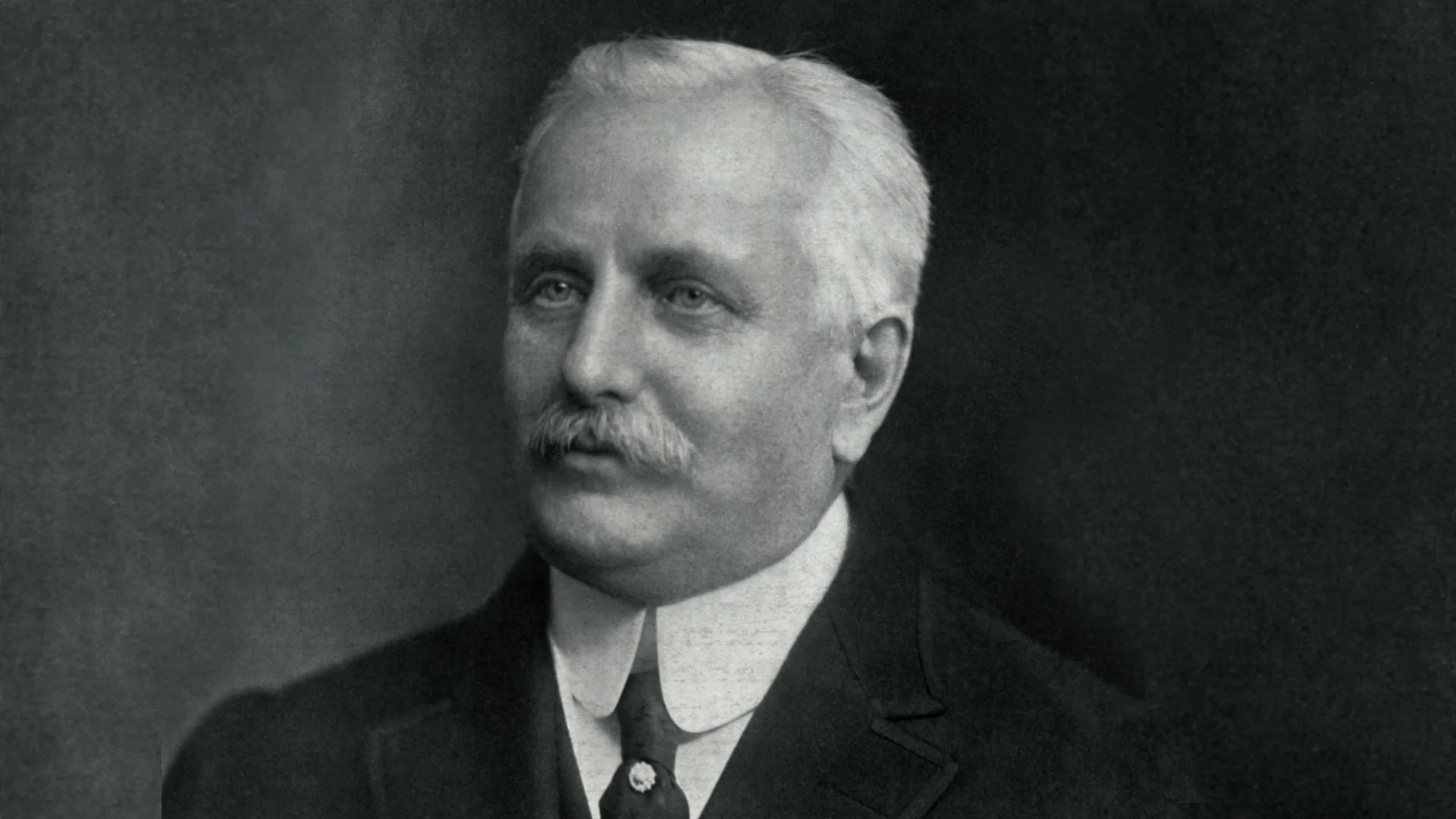
Frank Winfield Woolworth (1852 – 1919) was an American entrepreneur, and founder of the F. W. Woolworth Company. He pioneered the retail variety stores known as “Five and Dimes” which featured low-priced merchandise selling for 5 and 10 cents. His basic methodology is broadly used across most retail markets today.[1]
Unremarkable start. Frank was born in Rodman, New York. His parents were devout Methodists. At age 4, he told his parents he would like to become a salesman. But upon finishing primary school at age 16, he was unfit to work in a store, with only basic knowledge and no experience. He applied to every shop near his home, but was rejected. In 1873, he finally got a job as a stock boy in a general store. He was an inept salesman, but did such a good job setting up product displays that the owner assigned him that job.
By 1878 Woolworth organized a store in Grent Bend, but it failed in 90 days. His second attempt was a 5-cent store in Utica, New York, in 1879. It failed within weeks. The in April of that same year he opened a store that included 5- and 10-cent items. Within 10 years, Woolworth had 12 stores. In 1900, he had 59 stores, with sales over $5 million.
Rather that haggling on price, he bought merchandise directly from manufacturers and charged fixed prices. Customers could inspect the products on their own, instead of being handed a sample by a sales clerk. Woolworth began another modern retail practice—he acquired the smaller stores of competitors, squeezing out middlemen and giving him greater control of goods and distribution. As a result, he became a dominant force in the American retail industry.
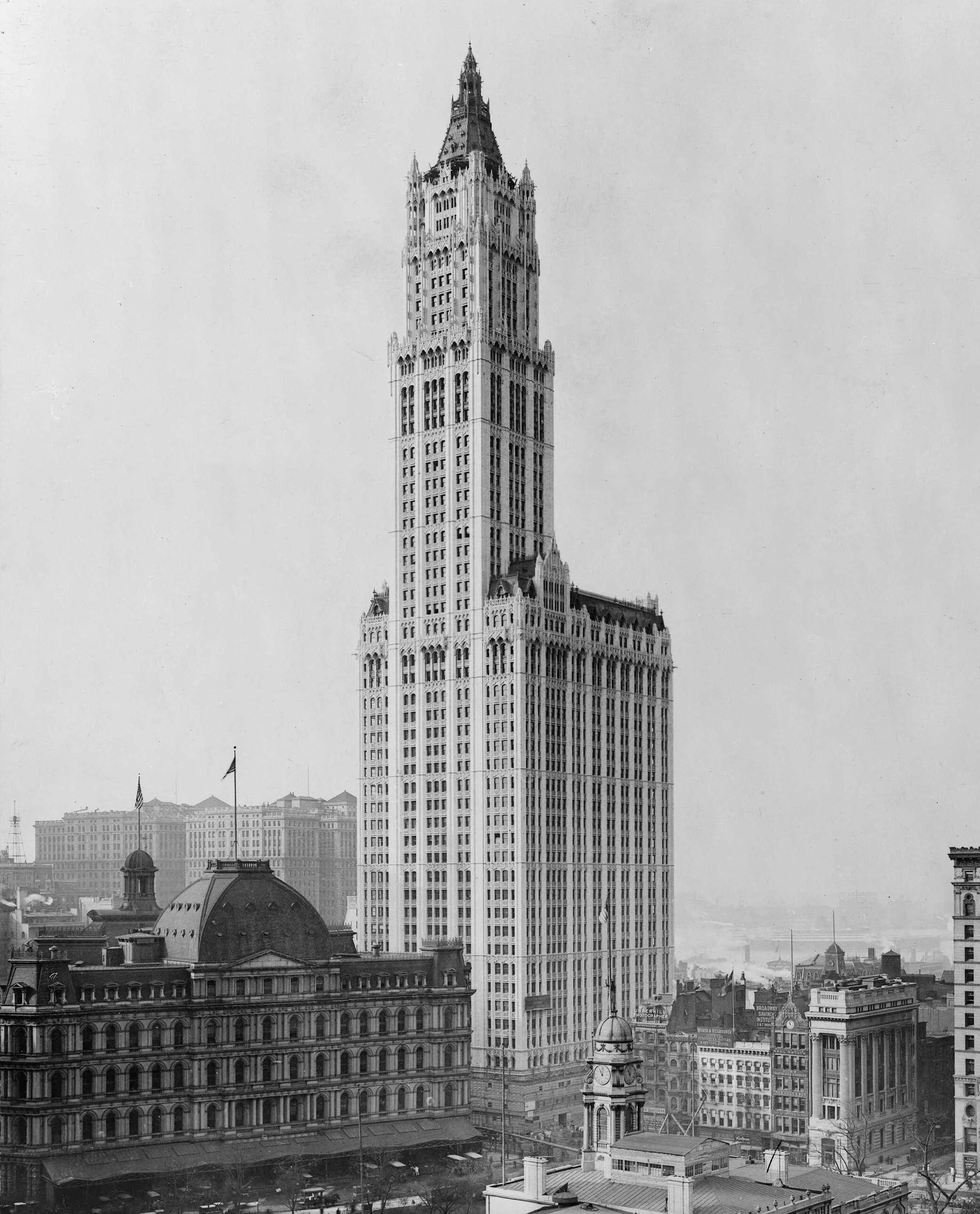
The Woolworth Building was the tallest in the world from 1913 to 1929. Today the top 30 floors are residences. Photo: Cass Gilbert, Woolworth Building, New York City, 1913
Explosive growth. In 1911, F.W. Woolworth company incorporated with 586 stores. It was a massive business. In 1913, Frank built the Woolworth Building in New York City at a cost or $13.5 million. At the time it was the tallest building in the world at 792 feet. The company eventually grew to more than 1,000 stores. In 1925 they had $253 million in sales. The stores later added lunch counters. The stores became local gathering places, precursors to the modern shopping mall and food court. The Woolworth concept was widely copied, and Woolworth stores would serve as anchors for suburban shopping plazas in the 1950s and 60s. By the company’s 100th anniversary in 1979, it had become the largest department store chain in the world.[2]
The fade. The F.W. Woolworth company’s retail practices—merchandising, direct purchasing, sales and customer service, are all commonly used today. By the 1980s, competition led to its decline. They tried to create a number of smaller specialty stores to operate out of shopping malls, but none were as successful as the five-and-dime concept. In 1993 the company embarked on a restructuring plan and closed half of its stores. Many of its stores at that time were sold to up-and-coming Wal-Mart.
The last of the stores went out of business in 1997, and the remaining assets—mostly sporting goods sales—became a part of Foot Locker, Inc. that company was acquired by rival Dick’s Sporting Goods in 2025. In 1998, Wal-Mart replace Woolworth’s on the Dow Jones Industrial Average. A remarkable era had come to an end.
Frank and his wife, Jennie, were married in 1876, and had three daughters. Their marriage was happy, though Jennie came to regret the demands of Frank’s ever-growing retail empire. She became mentally incapacitated, and died of dementia in 1924. Woolworth died of septic shock from an infected tooth in 1919. At the time of his death, he was worth $76.5 million.











William Shakespeare was an English playwright, poet and actor, widely regarded as the greatest writer in the English language. His works include plays, sonnets and other narrative poems.