
This series of articles seeks to examine the character attributes of highly successful leaders, regardless of their adherence to a strong faith or moral standard. In presenting these thoughts, Leadership Ministries is not agreeing with or advocating these traits or practices, but rather presents these as ideas for discussion and development in your own leadership journey.
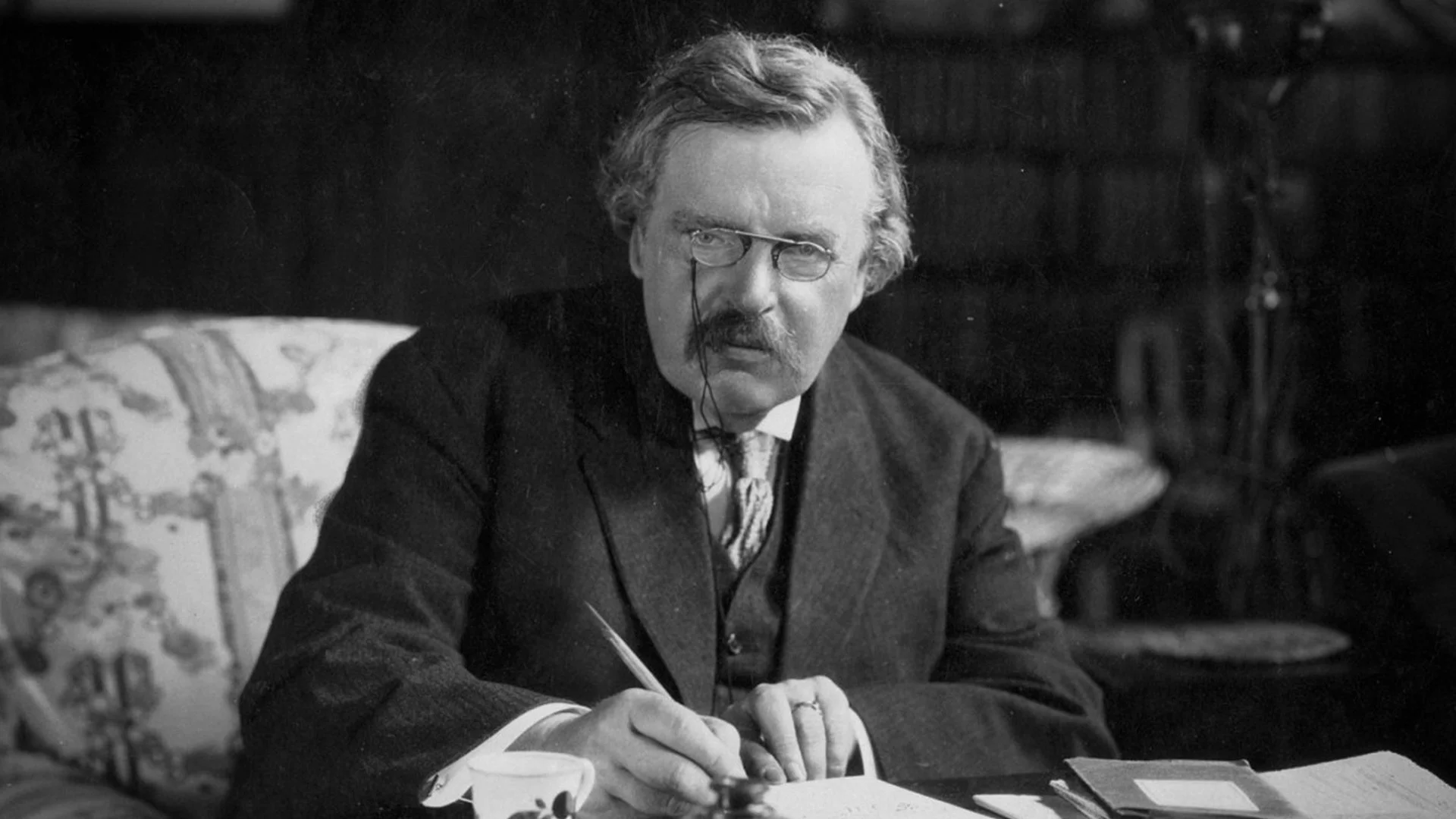
Gilbert Keith Chesterton (1874-1936) was an English Apologist. His sharp writing style made him a prominent figure in earth twentieth century literature. Among his works were Orthodoxy and The Everlasting Man. Chesterton loved to debate, and could be found in public discourse with men such as George Bernard Shaw, H.G. Wells, Bertrand Russell and Clarence Darrow.[1] Ironically, all of his opponents regarded Chesterton with the greatest affection. And George Bernard Shaw said: “The world is not thankful enough for Chesterton.”
Born in London, Chesterton was educated at St. Paul’s. Instead of college he went to art school. In 1900, he was asked to contribute a few magazine articles on art criticism. He went on to become one of the most prolific writers in history, penning hundreds of books, poems, plays, novels and more than 200 short stories. He considered himself primarily a journalist, writing more than 4,000 newspaper essays and 30 years worth of columns for the Illustrated London News.[2]
A singular voice. Chesterton wrote with ease on topics like social criticism, history, politics, economics, philosophy and theology. He was witty and his lines were profound, and perfectly memorable. He started writing for a London publisher in 1895, and by 1902 he had his own weekly opinion column. He invested a character, Father Brown, a priestly-detective he used to tell stories. Chesterton married in 1901 and remained with his wife through the remainder of his life. At 6 feet, 4 inches, he was an imposing man.
“Chesterton usually wore a cape and a crumpled hat, with a swordstick in hand and a cigar hanging out of his mouth. He had a tendency to forget where he was supposed to be going and miss the train that was supposed to take him there. It is reported that on several occasions he sent a telegram to his wife Frances from an incorrect location, writing such things as ‘Am in Market Harborough. Where ought I to be?’ to which she would reply, ‘Home.’”[3]
An influential writer. Chesterton’s book The Everlasting Man, led a young atheist named C.S. Lewis to come to faith in Christ. He wrote a novel called The Napoleon of Notting Hill, which inspired Michael Collins to lead a movement for Irish Independence. He wrote an essay in the Illustrated London News that inspired Mohandas Gandhi to lead a movement to end British colonial rule in India. Chesterton argued eloquently against all the trends that eventually took over the twentieth century: materialism, scientific determinism, moral relativism, and spineless agnosticism. He also argued against both socialism and capitalism and showed why they have both been the enemies of freedom and justice in modern society. T.S. Eliot said that Chesterton “deserves a permanent claim on our loyalty.”
Incredibly influential, yet largely unknown. Most modern thinkers and students have ever heard of G.K. Chesterton. Indeed he is no longer taught in school and most of his writings are on library shelves versus in literature textbooks. Perhaps this is because Chesterton’s arguments were difficult if not impossible to deny. To question his logic was a losing battle. Chesterton defended “the common man” and common sense. He defended the poor. He defended the family. He defended beauty. And he defended Christianity and the Catholic Faith. These don’t play well in the classroom, in the media, or in the public arena. And that is probably why he is neglected. Some of Chesterton’s more memorable quotes, include:[4]
“The Bible tells us to love our neighbors, and also to love our enemies; probably because generally they are the same people.”
“The most incredible thing about miracles is that they happen.”
“Fairy tales do not tell children that dragons exist. Children already know that dragons exist. Fairy tales tell children the dragons can be killed.”
“The whole modern world has divided itself into Conservatives and Progressives. The business of Progressives is to go on making mistakes. The business of Conservatives is to prevent the mistakes from being corrected.”
“The true soldier fights not because he hates what is in front of him, but because he loves what is behind him.”
“There is the great lesson of 'Beauty and the Beast,' that a thing must be loved before it is lovable.”
“A good novel tells us the truth about its hero; but a bad novel tells us the truth about its author.”
“If there were no God, there would be no atheists.”
“The way to love anything is to realize that it may be lost.”
“An adventure is only an inconvenience rightly considered. An inconvenience is only an adventure wrongly considered.”
“Do not be so open-minded that your brains fall out.”
“Religious liberty might be supposed to mean that everybody is free to discuss religion. In practice it means that hardly anybody is allowed to mention it.”
“We are perishing for want of wonder, not for want of wonders.”
“It is absurd for the Evolutionist to complain that it is unthinkable for an admittedly unthinkable God to make everything out of nothing, and then pretend that it is more thinkable that nothing should turn itself into everything.”
“The riddles of God are more satisfying than the solutions of man.”
“Hope is the power of being cheerful in circumstances that we know to be desperate.”
“These are the days when the Christian is expected to praise every creed except his own.”
“Let your religion be less of a theory and more of a love affair.”
G.K. Chesterton died of congestive heart failure on 14 June 1936, at his home in Beaconsfield, Buckinghamshire. The sermon at Chesterton's Requiem Mass in Westminster Cathedral, London, was delivered by Ronald Knox on 27 June 1936. Knox said, “All of this generation has grown up under Chesterton’s influence so completely that we do not even know when we are thinking Chesterton.”








[1] https://en.wikipedia.org/wiki/G._K._Chesterton
[2] https://www.chesterton.org/who-is-this-guy/
[3] Ward, Maisie (1944), Gilbert Keith Chesterton, Sheed & Ward
[4] https://www.crosswalk.com/faith/spiritual-life/20-wise-quotes-from-g-k-chesterton.html
Cover photo: Society of G.K. Chesterton, chesterton.org.
William Shakespeare was an English playwright, poet and actor, widely regarded as the greatest writer in the English language. His works include plays, sonnets and other narrative poems.