
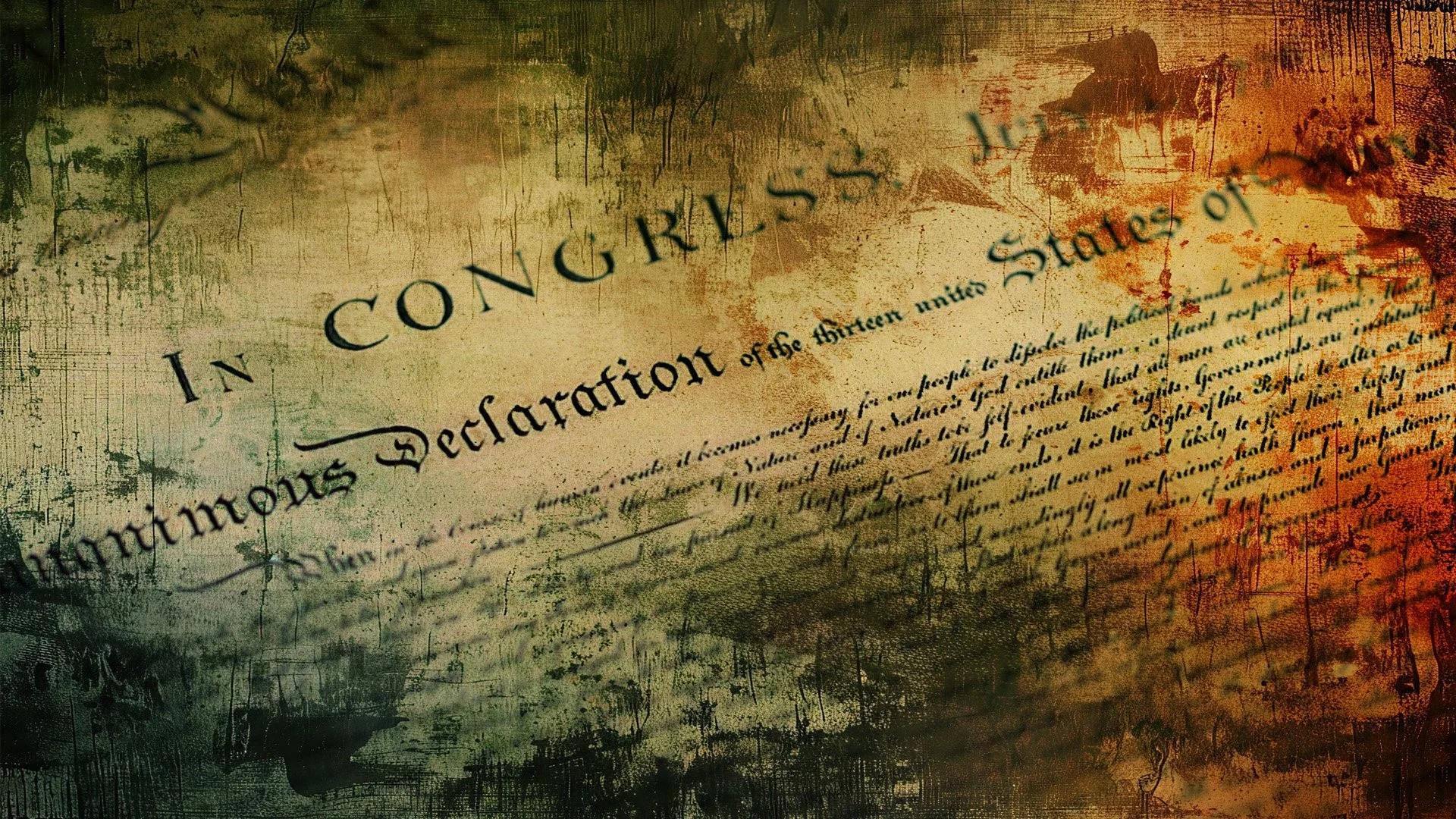
The Declaration of Independence was a document that laid out the reasons why the American colonies were about to go to war. Like an editorial, it was meant to be widely distributed, in an age before telegraphs, telephones or the Internet. After it was completed, a grass roots network began relaying the text to state assemblies, military commanders and public reading points.
Printer John Dunlap was commissioned to print 200 copies, known as broadsides, reproduced on large, single-sided sheets of paper, and then hastily folded and carried by post riders to cities and towns. Church pastors read the text aloud from their pulpits, and local leaders from their courthouse steps. The Declaration was even translated into other languages including French and German in order to reach non-English readers.
There was a gravity to the words of the Declaration. The words would undoubtedly lead to conflict and chaos once they reached the eyes and ears of King George III of England. For the revolutionaries in America there were parades, bonfires and 13-gun salutes. Many viewed the Declaration as a vital unification of the colonies. Some loyal to the Crown believed they had been betrayed. King George condemned the Americans’ “extravagant and inadmissible claim of independency” and ordered his Navy and Army to crush the rebellion.
But the Americans knew this would be the reaction and, so, they closed their document with a solemn pledge, describing the lengths they would go to in order to separate themselves from the British Crown. To this cause, they wrote, we pledge, “our lives, our fortunes, and our sacred honor.”
That last phrase, “sacred honor”, is important. It is a solemn, binding promise made by the signers to stake their integrity, reputation and moral standing on the success of the American Revolution. They would rather face death or ruin than betray their cause or break their word. Signing the document itself was an act of treason against the Crown. If captured, a signer would face death by hanging. There was, in fact, a real threat of death and loss of all personal and family property.
An Eighteenth Century gentleman considered his personal reputation and integrity to be his most prized possession. Honor, in the 1700s, was akin to a modern credit score, resume, education and moral reputation all rolled into one. A “sacred” honor was an elevated pledge—not just a covenant between men, but a holy, unbreakable oath before God. To abandon this duty would be an unpardonable betrayal.
The cost of signing the Declaration was high. Of the 56 signers, 17 had their homes looted, ransacked or burned. Five were captured and held as prisoners of war. All were poorer by the war’s end. Several had devastating personal losses, like Thomas Nelson, Jr., who bankrupted himself funding the war and died penniless. Others died from battle wounds or disease. Button Gwinnett (namesake of Gwinnett County, Georgia) died in a duel. Thomas Lynch, Jr. was killed in a shipwreck. Those that survived the war went on to hold positions in the new American government, including John Adams and Thomas Jefferson, who both served as President, and Benjamin Franklin, who brokered the Treaty of Paris which ended the Revolutionary War officially in 1783.
The story of the Declaration of Independence is one of sacrifice. What would men be willing to give up, to place on their own personal altar, in order to see through the formation of a new nation? What did they believe to be the cost of the freedoms they so desired? In this, each man’s pledge with his signature of his life, his fortune and his sacred honor spoke volumes to the readers throughout the colonies. The Declaration not only stated the case for independence, it was backed by the solemn oath of the signers to do whatever it took to secure it.
Today, 250 years removed from its beginnings, the American Experiment is bucking in spots. We argue over our freedoms—withholding some at times, and creating odd new ones that serve special interests but stray far from our roots. Interestingly, though the phrase has been quoted by many politicians and other leaders through the years, no other document or official oath contains the pledge to give “our lives, our fortunes and our sacred honor.” In this, the Declaration of Independence is unique.
As you reflect on history, and your own life today, is there something in your family, work or faith to which you might make this solemn pledge? What in your own world would be worth putting forth your life, your fortune and your sacred honor? Is there something that rises to that mark for you, or is this a declaration for the history books? It’s worth contemplating as we look at those who gave their all to birth a nation and codify the freedoms and rights that today we all enjoy.








The Declaration of Independence was a document that laid out the reasons why the American colonies were about to go to war. Like an editorial, it was meant to be widely distributed, in an age before telegraphs, telephones or the Internet.